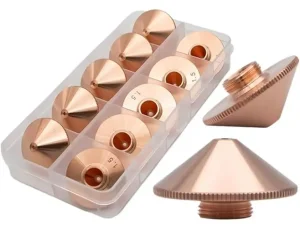
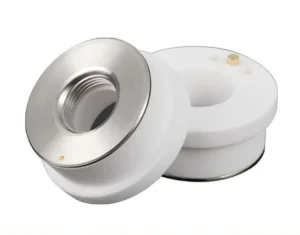
Explore Suchen's engineered nozzles, electrodes, and optical integration components designed for major laser and plasma cutting systems.
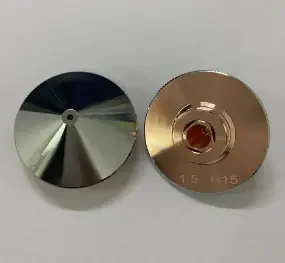
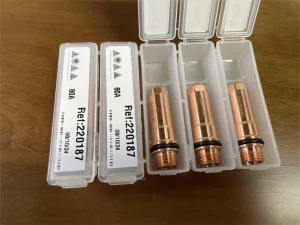
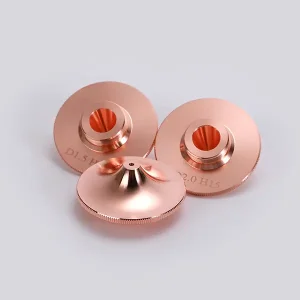
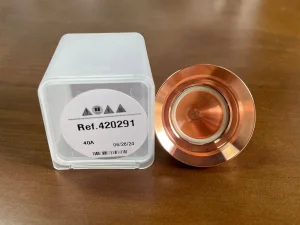
Achieving sub-micron accuracy in CNC laser cutting requires understanding key optical dynamics: thermal lensing, transmission coefficients, and specialized coatings.
High-power laser applications (10kW to 40kW+) generate extreme intensity profiles that heat optical elements. Thermal lensing occurs when an optical element absorbs part of the laser beam, changing its refractive index and shape. This causes a focal shift, altering cut kerf width and quality. Our OEM protective windows and focusing lenses are engineered using ultra-high-purity synthetic fused silica, maintaining a thermal absorption coefficient of under 50 ppm/cm to guarantee focal point stability during continuous operations.
An uncoated lens reflects a portion of the laser beam, leading to transmission loss and potential damage to the laser source. Our cleanroom coating facilities use Advanced Ion-Beam Sputtering (IBS) to apply multi-layer Anti-Reflective (AR) coatings. These coatings reduce reflectance to below 0.1% at wavelengths of 1030nm to 1080nm (fiber lasers) and 10.6μm (CO2 lasers), increasing power transmission and protecting internal optics from back-reflection.
Integrating OEM lenses into CNC laser systems requires exact matches for optical focal lengths (f = 125mm, 150mm, 200mm) and clear apertures. A minor variance in thickness or curvature can cause wavefront distortion, decreasing cutting efficiency on carbon steel, stainless steel, and highly reflective metals like aluminum and copper. Chengdu Suchen's optics are verified with Zygo interferometers, certifying surface flatness to within lambda/10.
Established in 2010 in the Qingbaijiang District of Chengdu, Chengdu Suchen Environmental Protection Materials Co., Ltd. has grown into a diversified group company. For over 14 years, we have served the international market by manufacturing and supplying high-performance components across three main sectors:
Our focus is on the global industrial market, supplying Fortune 500 enterprises and international OEMs. We combine advanced machinery with strict quality management systems to produce parts that match or exceed OEM specifications.
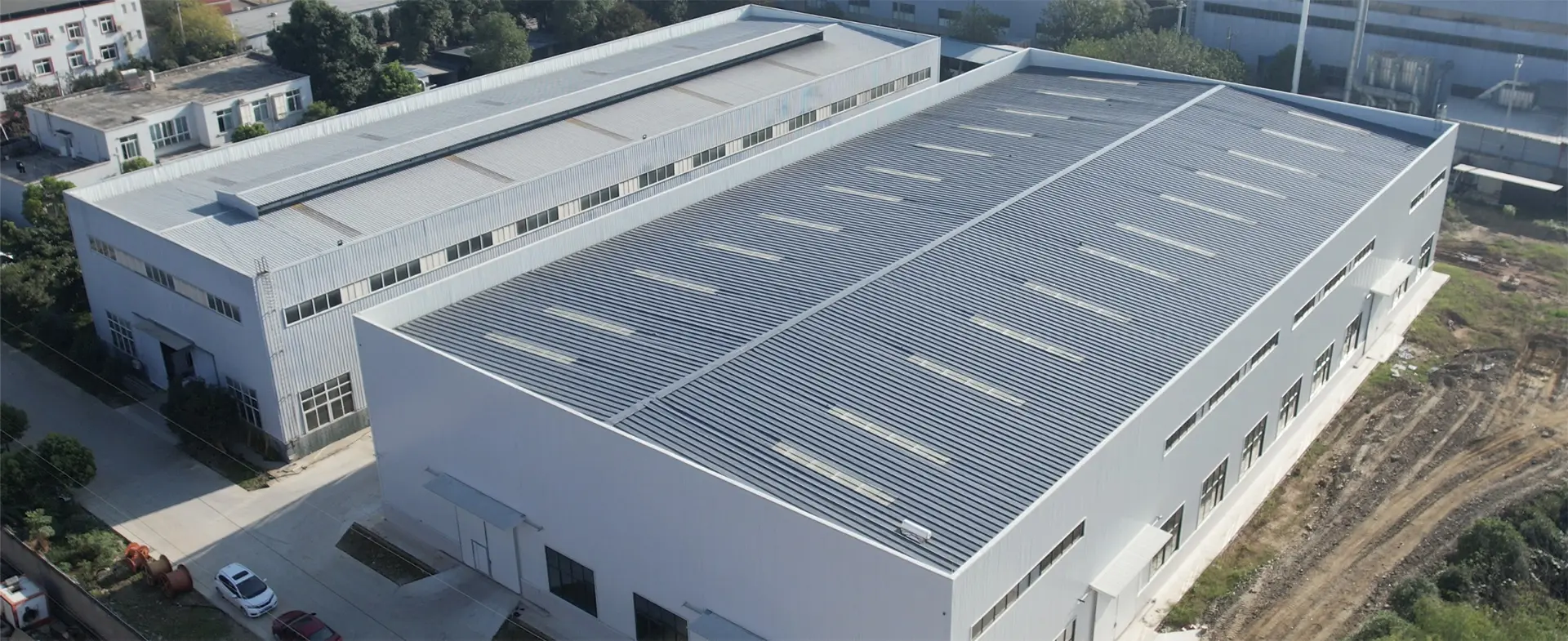
"Green Sustainable Development" guides our production processes. We actively use environmentally friendly raw materials and energy-efficient manufacturing systems. By minimizing waste and emissions, we align with global environmental policies, helping our international clients achieve clean supply chains.
Our manufacturing facilities in Chengdu combine supply chain integration, technical expertise, and scale to deliver cost-effective, high-quality optics.
China's manufacturing ecosystem provides direct access to high-purity synthetic quartz, raw ZnSe materials, and advanced optic coatings. Our facility in Chengdu leverages these local supplies to streamline production and insulate our clients from global logistics disruptions.
Our factory uses computer-controlled polishing machines and optical centering devices to achieve sub-micron concentricity and surface tolerances. Automated surface scans confirm that every lens matches strict scratch-dig standards (10-5 or better).
We provide rapid prototyping and high-volume manufacturing of custom diameters, edge thicknesses, and focal lengths. We support custom mounts and alignment configurations to match your machinery specifications.
Suchen components are integrated into major manufacturing sectors, providing stability and precision in heavy and light industries.
Automotive body-in-white (BIW) production lines demand high-speed, continuous laser cutting and welding. Suchen lenses and nozzles deliver the thermal stability and long lifetimes required to prevent downtime on automated assembly lines.
For micro-cutting of medical devices, semiconductor substrates, and delicate electronics, our high-precision nozzles and focusing lenses control spot size to minimize heat-affected zones (HAZ) and ensure clean cuts.
Cutting thick steel plate for heavy machinery and marine vessels requires lasers operating at 20kW to 40kW. Suchen optics and nozzles are engineered to withstand these high laser powers, ensuring consistent edge quality on carbon and stainless steels.
Job shops process a wide variety of materials and thicknesses daily. Suchen’s durable components help keep machine operators productive by reducing the frequency of lens replacement and nozzle calibration.
Our corporate systems are certified to international quality and environmental standards, and we focus on building collaborative relationships.

To become a globally recognized supplier of environmental materials and new energy components, driving the green transformation of the global manufacturing industry through ongoing technical innovation.

We advocate for "integrity, cooperation, and win-win." Integrity forms the foundation of our business development, and we value teamwork and knowledge-sharing to align interests with our partners.

We follow a "customer first" philosophy. We work with global partners to support green initiatives and sustainable development, providing responsive support for technical and supply needs.
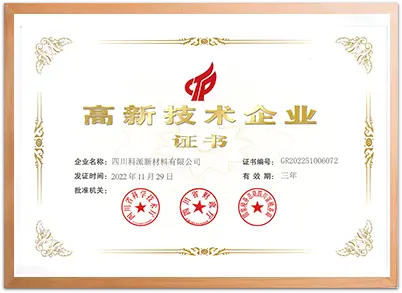
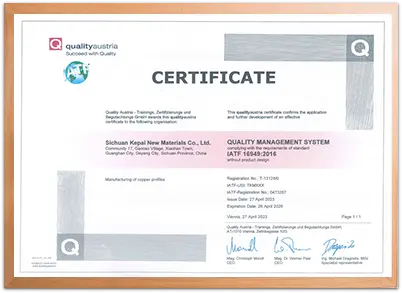
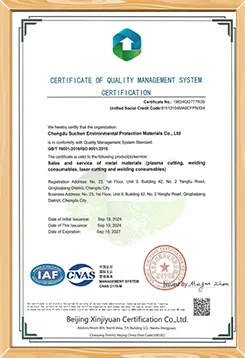
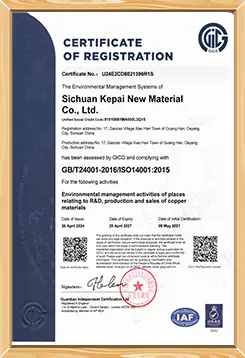
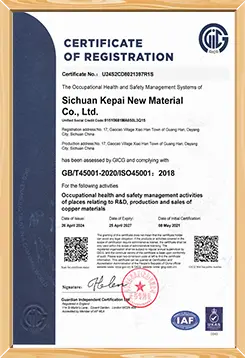
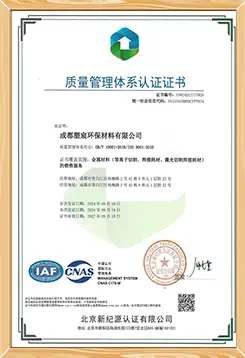
Our products and production systems carry international certifications. These verifications demonstrate our compliance with safety, environmental, and quality regulations, allowing us to supply components directly to global manufacturing assembly lines.



Find answers to common questions about thermal lensing, lens maintenance, and customized OEM optic orders.
Thermal lensing is caused by absorption of laser energy by the lens substrate or its coatings, which creates a temperature gradient across the optic. This gradient alters the index of refraction and causes physical expansion, shifting the focal point. To minimize this effect, we use high-purity synthetic fused silica with very low bulk absorption, combined with low-absorption anti-reflective coatings.
The lifespan of a protective window depends on the operating environment, cutting parameters, and cleanliness. In clean conditions, high-quality protective windows can last 80 to 120 hours of beam-on time. However, exposure to backspatter from pierce points or dust contamination can shorten their service life. Regular inspections and proper nozzle gas flow help extend window lifespan.
Fiber lasers operate in the near-infrared spectrum (1060-1080nm), where synthetic fused silica provides high transmission and a high damage threshold. Zinc Selenide (ZnSe) is optimized for the far-infrared spectrum of CO2 lasers (10.6μm) and is not suitable for fiber laser wavelengths due to differences in absorption and refractive properties.
For standard catalog sizes, parts are typically shipped within 3 to 7 business days. Custom OEM designs requiring unique focal lengths, geometries, or custom anti-reflective coatings usually have a lead time of 4 to 6 weeks, which covers substrate fabrication, precision polishing, IBS coating run cycles, and final optical inspection.
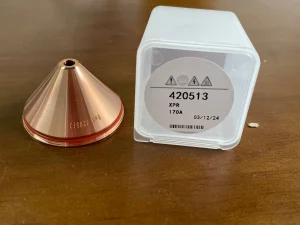
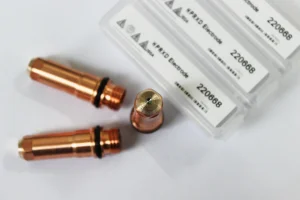
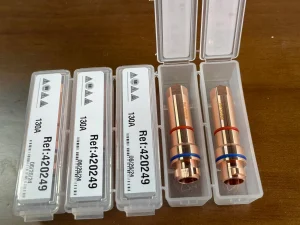
Explore Suchen's technical consumables, including plasma nozzles, electrodes, and custom laser components.
 SUCHEN